لطفا منتظر بمانید ...
0% Complete
رفتن به صفحه اصلی
ارائه مجازی مقاله
لیست نشست ها
نمایشگاه مقالات پوستری
مشخصات مقاله
کد مقاله
1114
منابع مقاله
عنوان
Predation of phytopathogenic Xanthomonas and Pantoea by Bdellovibrio sp. BDIR-1: A promising biocontrol potential?
نویسندگان
Salman Odooli
چکیده
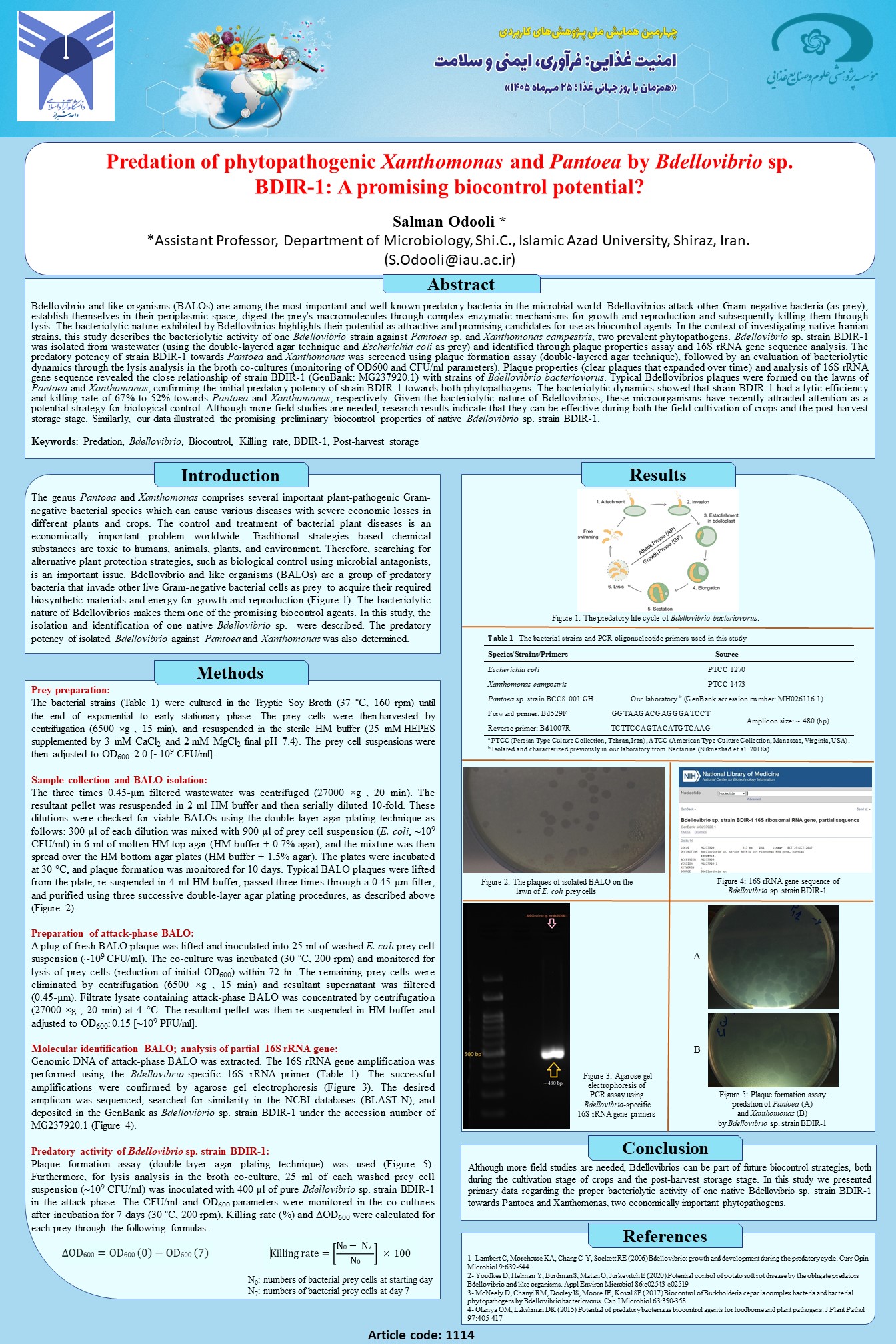
Bdellovibrio-and-like organisms (BALOs) are among the most important and well-known predatory bacteria in the microbial world. Bdellovibrios attack other Gram-negative bacteria (as prey), establish themselves in their periplasmic space, digest the prey's macromolecules through complex enzymatic mechanisms for growth and reproduction and subsequently killing them through lysis. The bacteriolytic nature exhibited by Bdellovibrios highlights their potential as attractive and promising candidates for use as biocontrol agents. In the context of investigating native Iranian strains, this study describes the bacteriolytic activity of one Bdellovibrio strain against Pantoea sp. and Xanthomonas campestris, two prevalent phytopathogens. Bdellovibrio sp. strain BDIR-1 was isolated from wastewater (using the double-layered agar technique and Escherichia coli as prey) and identified through plaque properties assay and 16S rRNA gene sequence analysis. The predatory potency of strain BDIR-1 towards Pantoea and Xanthomonas was screened using plaque formation assay (double-layered agar technique), followed by an evaluation of bacteriolytic dynamics through the lysis analysis in the broth co-cultures (monitoring of OD600 and CFU/ml parameters). Plaque properties (clear plaques that expanded over time) and analysis of 16S rRNA gene sequence revealed the close relationship of strain BDIR-1 (GenBank: MG237920.1) with strains of Bdellovibrio bacteriovorus. Typical Bdellovibrios plaques were formed on the lawns of Pantoea and Xanthomonas, confirming the initial predatory potency of strain BDIR-1 towards both phytopathogens. The bacteriolytic dynamics showed that strain BDIR-1 had a lytic efficiency and killing rate of 67% to 52% towards Pantoea and Xanthomonas, respectively. Given the bacteriolytic nature of Bdellovibrios, these microorganisms have recently attracted attention as a potential strategy for biological control. Although more field studies are needed, research results indicate that they can be effective during both the field cultivation of crops and the post-harvest storage stage. Similarly, our data illustrated the promising preliminary biocontrol properties of native Bdellovibrio sp. strain BDIR-1.
فایل ها
فایل jpeg-jpg پوستر
محتوای ارائه مجازی مقاله
نظرات
ثمین همایش، سامانه مدیریت همایش ها و جشنواره ها - نگارش 44.12.0

 فایل jpeg-jpg پوستر