لطفا منتظر بمانید ...
0% Complete
رفتن به صفحه اصلی
ارائه مجازی مقاله
لیست نشست ها
نمایشگاه مقالات پوستری
مشخصات مقاله
کد مقاله
1142
منابع مقاله
عنوان
Rapid Detection of Foodborne Zoonotic Pathogens: Emerging Technologies and Their Role in One Health Food Safety
نویسندگان
Seyed Matin Mousavi
چکیده
Foodborne zoonotic pathogens remain an important challenge for food safety and public health because they can be transmitted through contaminated foods and may cause outbreaks across different populations. Rapid detection of these pathogens is important for timely identification of contamination, outbreak investigation, and implementation of effective control measures. This review aimed to examine emerging technologies for the rapid detection of foodborne zoonotic pathogens and to discuss their potential role in One Health food safety. Recent scientific literature was reviewed with particular attention to molecular and advanced diagnostic approaches, including polymerase chain reaction (PCR), loop-mediated isothermal amplification (LAMP), whole-genome sequencing (WGS), metagenomic methods, and biosensor-based technologies. The reviewed literature indicates that molecular methods such as PCR and LAMP can provide faster detection of specific foodborne pathogens than conventional culture-based approaches, while WGS can provide high-resolution information for strain characterization, outbreak investigation, and source attribution. Metagenomic methods have the potential to detect multiple microorganisms and antimicrobial resistance determinants directly from complex samples, whereas biosensor-based technologies may offer rapid and portable detection suitable for on-site applications. However, differences in sensitivity, specificity, cost, equipment requirements, sample preparation, and standardization can affect the routine application of these technologies. The reviewed evidence suggests that no single method is sufficient for all food safety situations and that the choice of diagnostic technology should depend on the pathogen, sample type, required detection time, and available resources. Integrating rapid diagnostic technologies with conventional microbiological methods and surveillance across animals, food, humans, and the environment may improve early detection and risk assessment. Overall, the use of emerging rapid detection technologies within a One Health framework can contribute to faster and more coordinated responses to foodborne zoonotic hazards.
فایل ها
فایل jpeg-jpg پوستر
محتوای ارائه مجازی مقاله
نظرات
ثمین همایش، سامانه مدیریت همایش ها و جشنواره ها - نگارش 44.12.0

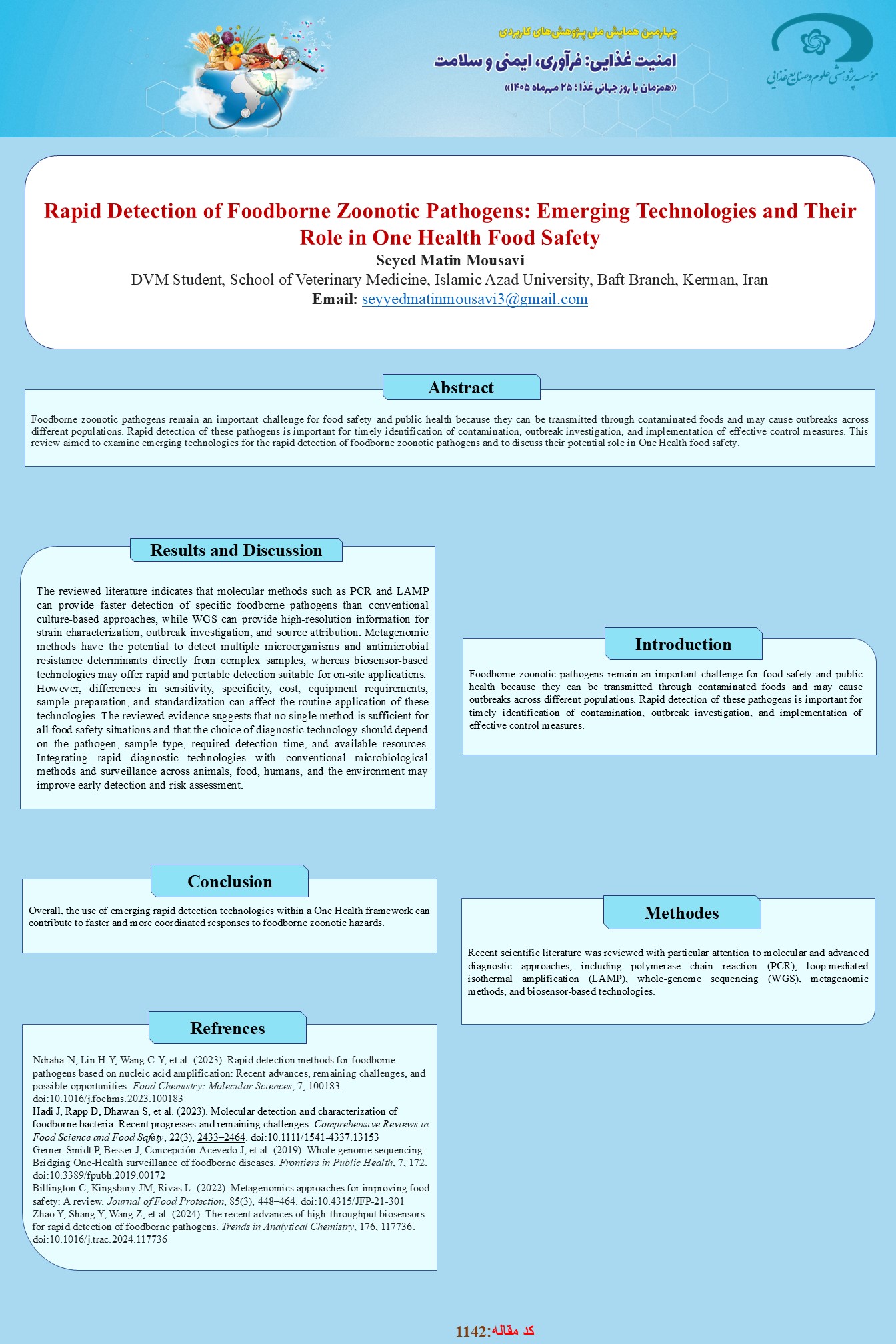 فایل jpeg-jpg پوستر